

Ballroom Dress Guide 2026: Trends, Budget & Custom Fit
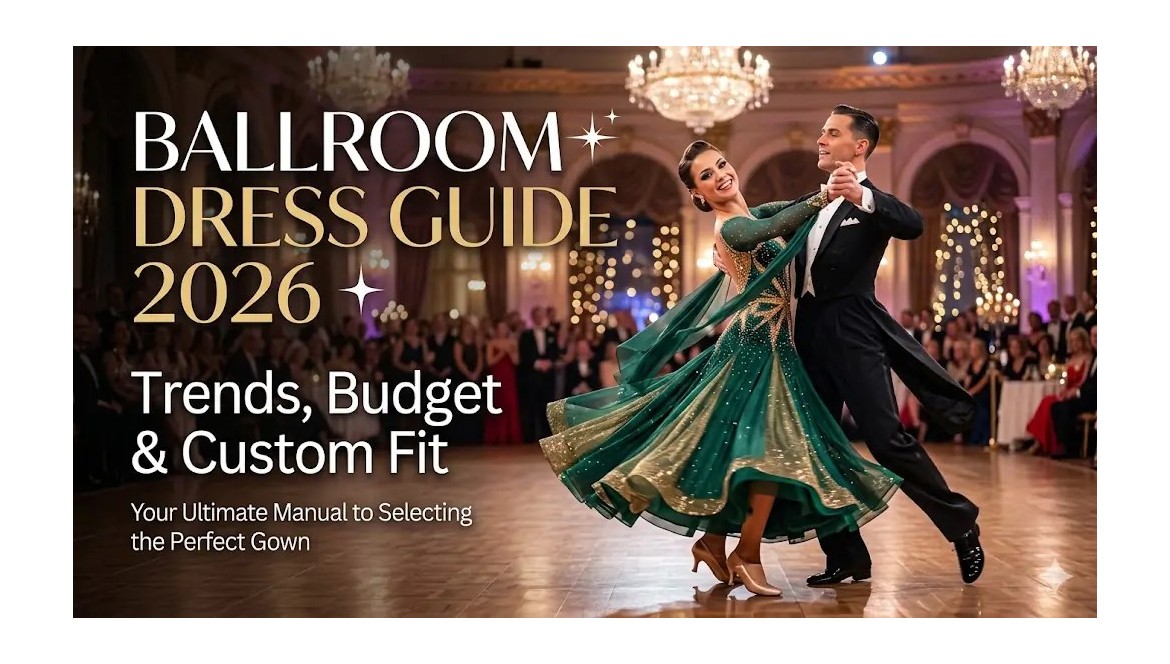
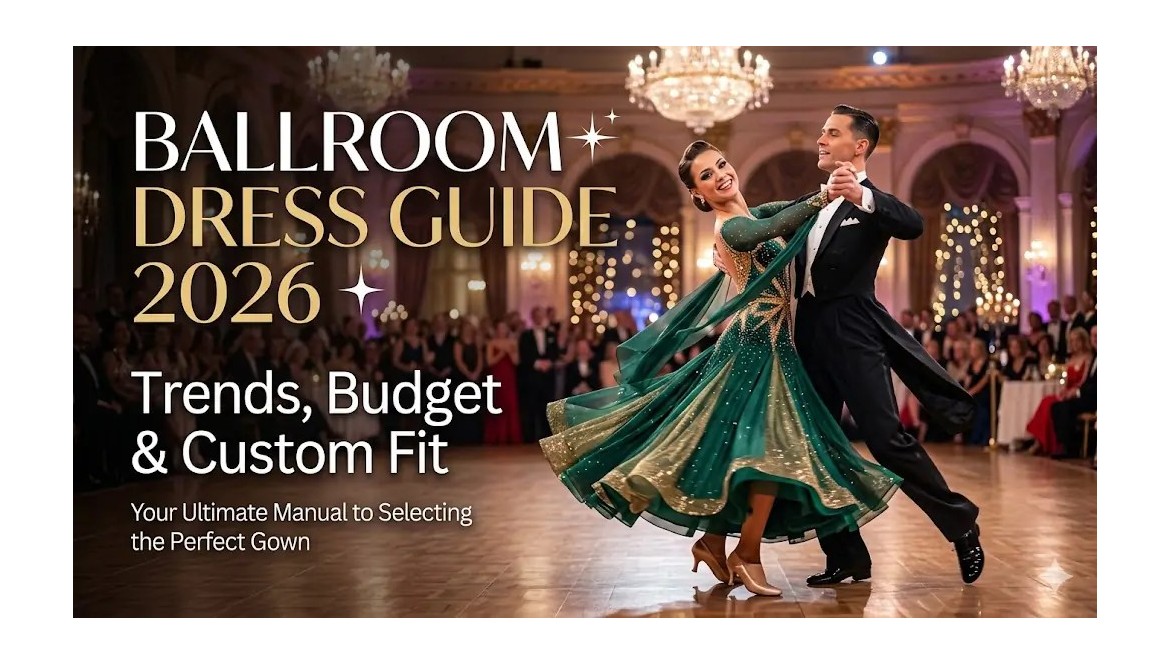
2026 ballroom dress guide: metallic trends, budget tips & custom fit. Learn how to choose a competition dress that wins — with free custom sizing from Venus Dancewear.
2026 Ballroom Dress Guide: How to Choose the Perfect Competition Dress
I still remember the first time I zipped up a dress that was made for me — not just my size, but my body, my movement, my dance. That feeling? It changes everything. Whether you're preparing for your first syllabus competition or aiming for the Open Championship podium, this ballroom dress guide will help you find the ideal competition dress for the 2026 season without the guesswork, the stress, or the expensive mistakes.
Choosing a competition dress is one of the most exciting milestones in a dancer's journey. It's also one of the easiest places to spend too much on the wrong thing. The wrong color can wash you out under stage lights. An ill-fitting bodice can restrict your frame in a Waltz or limit your hip action in a Cha-Cha. A rushed timeline can leave you scrambling before a major event. We've watched dancers walk into competitions with dresses that didn't arrive on time, didn't fit, or simply didn't feel like them on the floor.
Good news? You don't have to learn these lessons the hard way. Over the next few minutes, we'll cover: what's trending for 2026 (and what's not), how to match a dress to your dance style and body type, the fabric and fit tricks that separate good dresses from great ones, and when custom sizing is worth it — and when it's overkill. By the end, you'll know exactly what to look for.
Key Takeaways
- This ballroom dress guide covers the top 2026 trends, fit tips, and budget strategies for every dancer
- Ballroom gowns (Standard/Smooth) require floor-length flowing designs, while Latin dresses call for shorter hemlines, stretch fabrics, and maximum freedom of movement
- The "30% hidden rule" means alterations, undergarments, and shipping can add up to 30% beyond the dress price
- Custom sizing from Venus Dancewear comes at no extra charge — a rare advantage in the custom dress market
- Strategic crystal placement, not just quantity, catches a judge's eye
2026 Ballroom Dress Trends You Need to Know
Walk into any ballroom in 2026 and you'll notice something immediately: the dresses are shining differently. Metallic fabrics, bold crystal work, sculpted silhouettes — this season's trends aren't subtle, and that's the point.
(For context: the global dancewear market is estimated at roughly USD 0.66 billion in 2026, growing around 4.4% annually — which means more brands, more options, and more competition for your attention.)
Metallic Fabrics Take Center Stage
If there's one trend that defines 2026, it's high-shine metallics. Silver and rose gold fabrics are dominating both ballroom gowns and Latin dresses. Unlike traditional satin or chiffon, metallics catch and reflect stage lighting from every angle, creating a halo effect around your movements. Every turn and extension becomes more visible to judges from across the floor.
Dancers are increasingly choosing metallic finishes not just for Latin — where high shine has always been welcome — but also for Standard and Smooth categories, where the reflective quality adds a modern edge to classic silhouettes.
Bold Embellishments & Strategic Stoning
The "more is more" philosophy holds strong in 2026, but with a crucial shift: strategic placement over sheer volume. Designers are using Swarovski crystals with surgical precision — clustering stones along necklines, waist seams, and hem edges to guide the judge's eye toward your best lines.
Venus Dancewear, a verified SWAROVSKI ELEMENTS supplier, uses genuine crystals in all their competition dresses. This matters because imitation crystals lack the clarity to sparkle under competition lighting. A dull crystal on the floor is a missed opportunity.
Mini Story — The Crystal Cascade Effect
Sarah, an Open-level Smooth dancer from Chicago, was hesitant about investing in heavier crystal embellishment for her first championship gown. Her coach convinced her to opt for a crystal-clustered bodice on a midnight navy base. The result? At her first competition, two judges commented on how "she lit up the floor" during her Viennese Waltz. She placed first in a field of twelve. Sarah now tells every dancer she mentors: "The crystals didn't win the dance — but they made sure the judges saw the dance."
Structured Silhouettes & the "Entrance Factor"
Architectural design elements are making a major comeback. Think oversized bows, sculpted peplums, dramatic capes, and asymmetric draping. These aren't just decorative — they create what industry insiders call the "entrance factor," the visual impact you make the moment you step onto the floor.
For Standard and Smooth gowns, this means structured bodices with built-in support and dramatic skirt volumes that flow beautifully during rotational movements — the Natural Turn in Waltz, the Feather Step in Foxtrot.
Color Trends for 2026
This year's palette strikes a balance between sophistication and boldness:
| Trend Color | Best For | Why It Works |
|---|---|---|
| Midnight Navy | Ballroom gowns, Smooth dresses | Deeper than black, reads as elegant under lights |
| Champagne & Sand | Standard gowns | "Old Money" aesthetic — clean, refined, timeless |
| Rose Gold | Latin dresses, Rhythm costumes | Warm metallic that flatters most skin tones |
| Emerald & Royal Purple | All categories | Jewel tones that pop under stage lighting |
| Electric Lime & Hot Pink | Latin showcase dresses | High-energy colors for high-impact routines |
Quick tip: When choosing your color, ask your studio about their competition lighting setup. Fluorescent lighting can neutralize some colors, while warm lighting amplifies gold and red tones. A dress that looks stunning in the dressing room may read completely differently under competition lights.
Browse the latest ballroom competition dresses →
Ballroom vs Latin Dance Dresses: What's the Difference?
One question we hear constantly — especially from dancers transitioning between disciplines — is whether a single dress can work for both Ballroom and Latin. The short answer: almost never. These two categories demand fundamentally different designs.
Standard/Smooth Ballroom Gowns
Ballroom gowns (for Waltz, Tango, Foxtrot, Quickstep, and Viennese Waltz) are designed around flow:
- Full-length hemlines that sweep the floor, creating elegant lines during gliding movements
- Flowing fabrics — chiffon, organza, satin — that move with your body, not against it
- Structured bodices with built-in boning to maintain frame integrity
- Crystal embellishment concentrated on the bodice and upper skirt
- Closed-back or semi-open designs that maintain the standard frame silhouette
The key idea: the fabric should extend your movement, not restrict it. When you finish a turn in a Viennese Waltz, the skirt should continue rotating even after your body has stopped — creating that signature floating effect judges reward.
Latin/Rhythm Dresses
Latin dresses (for Cha-Cha, Rumba, Samba, Paso Doble, and Jive) follow a completely different philosophy:
- Shorter hemlines — above the knee to mid-thigh — to reveal leg action and footwork
- Stretch fabrics — lycra, stretch mesh, spandex blends — for explosive hip and leg movements
- Fringe, godets, and cascading crystals that accentuate every hip twist and body roll
- Open backs and cutouts for maximum range of motion
- High-saturation colors designed to grab attention in fast-paced routines
A Latin dress is an amplifier. Every fringe strand should catch the light during a spin. Every crystal cascade should follow your hip action in a Rumba walk. The best Latin dresses don't just hang on the body — they move with it.
Quick-Reference Comparison Table
| Feature | Ballroom Standard/Smooth | Latin/Rhythm |
|---|---|---|
| Skirt Length | Floor-length, ankle-grazing | Above knee to mid-thigh |
| Primary Fabrics | Chiffon, satin, organza, tulle | Lycra, stretch mesh, spandex |
| Silhouette | A-line, full skirt, mermaid | Fitted bodice, flared or fringe skirt |
| Embellishment Style | Concentrated on bodice and upper skirt | Full-body — fringe, crystals, godets |
| Back Design | Closed to semi-open | Often open or strappy |
| Movement Priority | Smooth gliding, rotational flow | Explosive hip action, leg lines |
| Best For | Waltz, Tango, Foxtrot, Quickstep, VW | Cha-Cha, Rumba, Samba, Paso, Jive |
| Price Range (Venus) | 699−699−4,999 | 422−422−2,750 |
Shop Latin dance dresses for competition →
How to Choose a Ballroom Dress: A Complete Step-by-Step Guide
This ballroom dress guide wouldn't be complete without a clear process. Here are the five steps we recommend to every dancer.
Step 1: Know Your Competition Level & Rules
Before you fall in love with a dress, check your competition organization's rules. Different bodies have different requirements:
- NDCA (National Dance Council of America): Syllabus dancers may face restrictions on stone coverage, skirt length, and color — see the official 2026 costume specifications (PDF) for the latest rules
- WDC (World Dance Council): More flexibility at professional levels, with specific rules about hemline height for Latin
- Collegiate & Amateur Events: Often adopt NDCA rules but may have local variations
- Pro/Am Competitions: Generally the most flexible, but check with your studio
The worst feeling is buying a beautiful gown only to be told at check-in that it violates competition rules. Verify first.
Step 2: Set Your Real Budget
Here's a reality check many dancers overlook: the price tag on the dress is not the full cost. We call this the "Hidden 30% Rule."
| Expense | Estimated Cost |
|---|---|
| Dress (base price) | 699−699−4,999 |
| Alterations (even with custom sizing) | 50−50−200 |
| Undergarments (shapewear, bra cups) | 30−30−150 |
| Shipping & insurance | 25−25−80 |
| Jewelry & accessories | 40−40−200 |
| Total with hidden costs | Base price + 15-30% |
A 900dressrealisticallycostsaround900dressrealisticallycostsaround1,080 to $1,170 when all is said and done. Plan for this upfront.
Step 3: Choose Your Color Strategy
Your dress color does more than look pretty — it influences how judges perceive your movement. Here's how to approach it:
- Skin tone analysis — Hold fabric swatches against your skin under both natural and stage lighting. Warm undertones glow in gold, champagne, and coral. Cool undertones shine in silver, midnight blue, and jewel tones.
- Stage lighting test — Ask your studio to let you see fabric samples under their competition lighting. Colors shift dramatically between fluorescent and warm stage lights. I once saw a dancer who looked stunning in emerald in the dressing room — but under fluorescents, she looked washed out.
- Partner coordination — If competing with a partner, one of you wears a bold color, the other wears a neutral or complementary tone.
- Match your color to your dance — Bright colors (red, electric blue, emerald) naturally draw the eye; they say "look at me." Softer tones (champagne, blush, lavender) say "watch how I move." Neither is wrong. The question is: what story is your dance telling?
Mini Story — The Color That Almost Wasn't
When Marcus and Elena started preparing for their first Open-level Standard competition, Elena had her heart set on a dramatic black gown. Her coach gently suggested midnight navy instead. Skeptical but trusting the advice, Elena ordered a custom navy gown from Venus Dancewear. At the competition, she noticed several other female dancers wearing black — and they seemed to disappear against the dark background walls. Her midnight navy dress stood out distinctly. "I would have been invisible," she told her coach afterward. "I learned that black is not always the safe choice."
Step 4: Prioritize Fit & Movement
Fit is everything. A beautiful dress that doesn't move with you is a liability, not an asset.
Use the "Three-Point Fit Test" to evaluate any dress:
- Arms up test: Raise both arms above your head as if in a V-shot. The bodice should stay in place without riding up or shifting sideways.
- Forward extension test: Extend your arms forward into dance frame. Check for pulling across the shoulders, gaping at the armholes, or strain across the back.
- Hip rotation test: For Latin dresses, rotate your hips through a full Rumba walk pattern. The skirt and fringe must move independently of your torso — if the dress twists or binds, the fit is wrong.
This is where custom sizing becomes a game-changer. Every Venus Dancewear dress is made to your exact measurements at no extra charge, which means your "Three-Point Fit Test" has a much higher chance of passing on the first try.
Step 5: Plan Your Timeline
Custom dresses take time. Here's a realistic schedule:
| Timeline | Action |
|---|---|
| 12-16 weeks before | Place your custom dress order |
| 8-10 weeks before | Receive first fitting photos from maker |
| 6-8 weeks before | Request any adjustments |
| 2-4 weeks before | Receive dress, do final fitting |
| 1 week before | Break in the dress during practice |
Ordering late is the number one mistake dancers make. Dresses ordered 4 weeks before a competition often require rushed shipping — more cost, less flexibility.
Fabric & Material Guide: What Works Best for Competition?
The fabric you choose determines how your dress looks, moves, and holds up over a season. Ordering a custom ballroom dress means you get to choose exactly what works for you.
Best Fabrics for Ballroom Gowns
| Fabric | Best For | Key Quality |
|---|---|---|
| Chiffon | Overskirts, overlays | Lightweight, translucent, flows beautifully in rotation |
| Satin | Bodices, main skirts | Smooth finish, holds shape, excellent light reflection |
| Organza | Layered skirts, volume | Stiff enough to hold structure, light enough to move |
| Tulle | Underskirts, accents | Adds volume without weight, excellent for layering |
Best Fabrics for Latin Dresses
| Fabric | Best For | Key Quality |
|---|---|---|
| Lycra/Spandex | Bodices, main dress | Four-way stretch, hugs body, moves with explosive action |
| Stretch Mesh | Sleeves, back panels, overlays | Breathable, skin-toned options, second-skin fit |
| Lame | Showcase dresses | Metallic sheen, lightweight, dramatic stage presence |
Fabrics to Avoid
- 100% cotton — Absorbs sweat, loses shape, looks flat under lights
- Cheap polyester — Pills, doesn't breathe, looks cheap on the floor
- Non-stretch fabrics in Latin dresses — Any dress labeled "no stretch" for Latin is a red flag
- Heavy velvet in ballroom gowns — Beautiful but heavy; can drag during fast rotations
All Venus Dancewear competition dresses use premium materials, with the option to upgrade to European Fabric for enhanced drape and shine. Each dress is finished with genuine Swarovski Elements crystals — never imitation.
Custom Ballroom Dress vs Ready-Made: Which Is Right for You?
One of the biggest decisions you'll make is custom versus ready-made. Let's be real about the trade-offs.
The Advantage of Custom-Made Dresses
Custom sizing isn't a luxury — for serious competitors, it's a necessity:
- Perfect fit for your unique body: No two dancers have identical proportions. Custom sizing accounts for your specific bust, waist, hip, arm, and torso measurements.
- Design personalization: Choose your colors, crystal density, neckline style, and embellishment placement.
- Competition-ready from day one: No costly alterations needed.
- No compromise on movement: The dress is built around your range of motion.
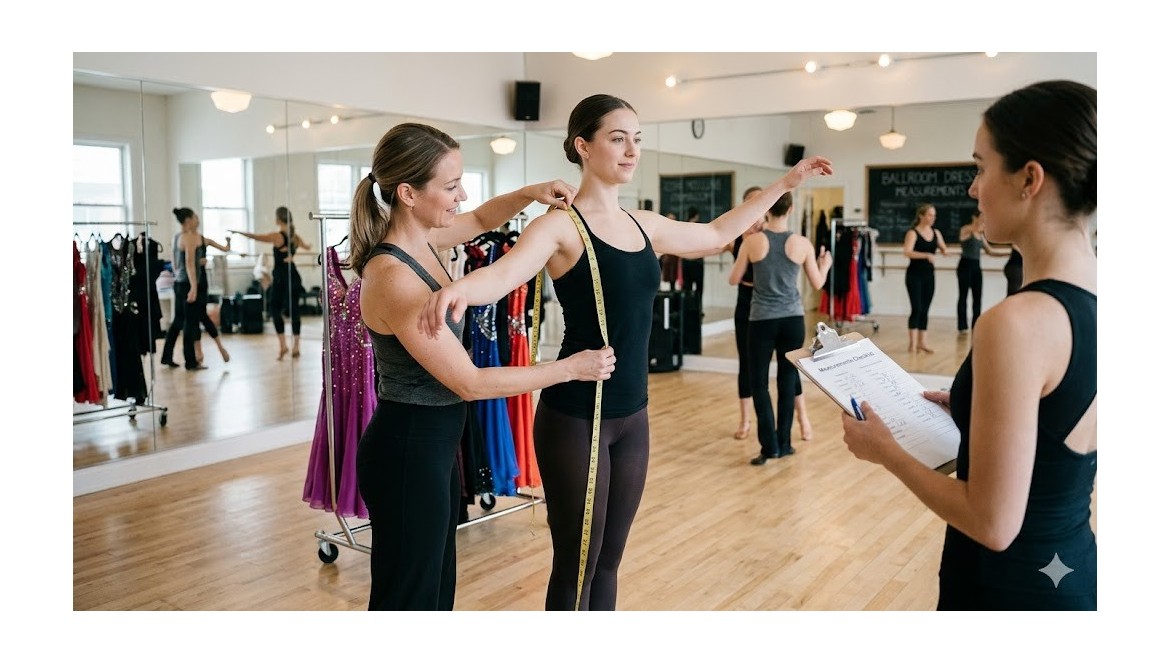
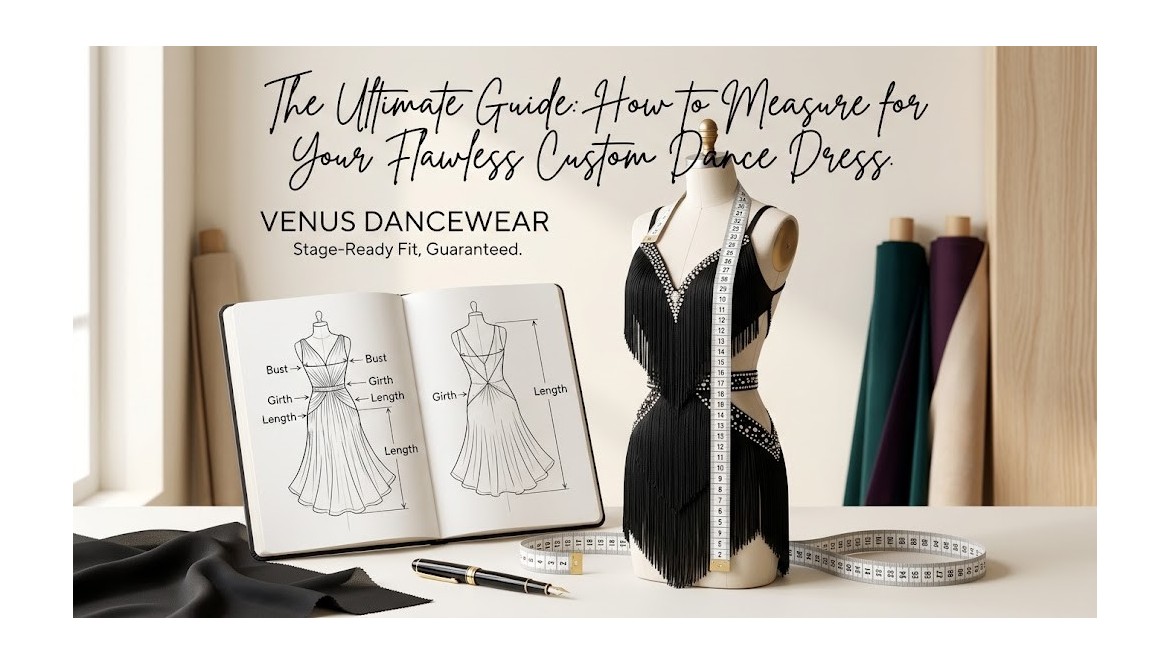
How to Take Your Measurements for a Custom Ballroom Dress
Getting accurate measurements is critical. Here's the checklist:
- Bust: Measure at the fullest point, wearing the bra you'll compete in
- Waist: Measure at the narrowest point (usually 1-2 inches above the belly button)
- Hips: Measure at the widest point, 7-9 inches below the waist
- Shoulder to waist: From the top shoulder seam to your natural waistline
- Arm length: From shoulder point to wrist bone, arm slightly bent
- Torso length: From shoulder to crotch level, front and back
Pro Tip: Have a professional seamstress or a trusted friend take your measurements — never do it yourself. Stand in a relaxed, natural posture (not sucking in) for the most reliable results.
Why Venus Dancewear's Custom Sizing Stands Out
Here's what makes Venus different from most competitors: custom sizing at zero additional cost.
Many dancewear companies charge 100to100to500 extra for made-to-measure. Venus includes it as a standard feature on every dress. Combined with free worldwide shipping on orders over $199, you get a dress tailored to your exact body and delivered without hidden fees.
Ballroom Dress Budget Guide 2026: Quality at Every Price Point
Whether you're a newcomer on a tight budget or a seasoned champion, there's a quality dress at your level.
Entry-Level & Budget-Friendly (400−400−900)
Best for: Syllabus dancers, collegiate competitors, dancers trying a new category.
Well-constructed dresses with moderate crystal embellishment using Venus Crystals. Venus's Intro Showcase Latin dresses start at $422, making this an accessible entry point for custom-sized competition wear.
Mid-Range (900−900−2,000)
Best for: Intermediate competitors, Pro/Am dancers looking to upgrade embellishment.
European fabric options, enhanced crystal packages (including Swarovski), more complex design elements — fringe, godets, layered skirts. Most of Venus's Elite Competitive line lives here.
Premium & Pro Champion (2,000−2,000−5,000)
Best for: Open-level competitors, professional dancers, championship events.
Full Swarovski crystal coverage, premium European fabrics, complex architectural design elements (oversized bows, capes, custom draping). Venus's Pro Champion dresses are designed to compete at the highest levels.
Mini Story — The Budget That Worked
Jessica, a college sophomore and newcomer to Pro/Am Smooth, had saved exactly 850forherfirstcompetitiondress.Sheworrieditwasn′tenough.Ratherthancompromisingonfit,sheorderedacustomVenusDanceweargowninthe850forherfirstcompetitiondress.Sheworrieditwasn′tenough.Ratherthancompromisingonfit,sheorderedacustomVenusDanceweargowninthe699 range — champagne chiffon with moderate crystal detailing. The dress arrived three weeks before her competition. She placed second in her Silver Smooth scholarship. "I was worried the cheaper dress would look 'budget,'" she says. "But nobody knew what I paid — they just saw a beautiful, well-fitted gown. The custom sizing made all the difference."
Shop affordable competition dresses on sale →
<h2 style="font-size:13px;color:#3b3b3b;
Comments
No comment at this time!
Leave your comment